

Nobody ever leaves an event saying, “The sound was brilliant, I heard every word.” They only talk about it when it goes wrong: the best man’s speech lost to feedback, or a keynote delivered to a room of people politely pretending to hear.
Good event sound is invisible, and it takes a little planning to get there. Here’s how to think it through, whether you’re organising a wedding or a conference anywhere in the UK.
Start with the venue and room size
The room decides a lot before you’ve chosen a single speaker. A big hall with hard walls and a high ceiling will bounce sound around and make speech muddy. A low-ceilinged function room might need very little power at all. Marquees, barns and country houses each have their own quirks.
Ask the venue about dimensions, ceiling height, power supply and whether there’s an in-house system. Think about your guests too: how many will there be, and where will they sit, stand or dance? A long, narrow room usually needs speakers placed differently from a square one, so that people at the back aren’t getting a blast at the front’s expense.
Decide what the sound actually needs to do
Speech and music ask different things of a system. Speech needs clarity, so every word is understood in every seat. Music, especially for dancing, needs weight and energy.
Make a short list of what’s happening on the day: ceremony, speeches, presentations, background music, a band, a DJ, awards, a first dance. A wedding might move from a quiet ceremony to a full dancefloor in an afternoon. A corporate event might run from a panel discussion to an after-party. Knowing the running order lets you plan the right kit for each part, rather than one setup that does everything averagely.
Choose the right speakers and microphones
For speakers, think in terms of coverage rather than sheer volume. Several well-placed, moderately powered speakers usually sound better and more even than one enormous pair shouting from the front. Subwoofers help with music but are rarely needed for speeches alone.
For microphones, a few sensible rules:
- Handheld mics suit toasts, hosts and Q&A, as they’re easy to pass around.
- Lapel or headset mics free up a speaker’s hands, which is handy for presenters and ceremonies.
- Lectern mics work for formal talks where the speaker stays put.
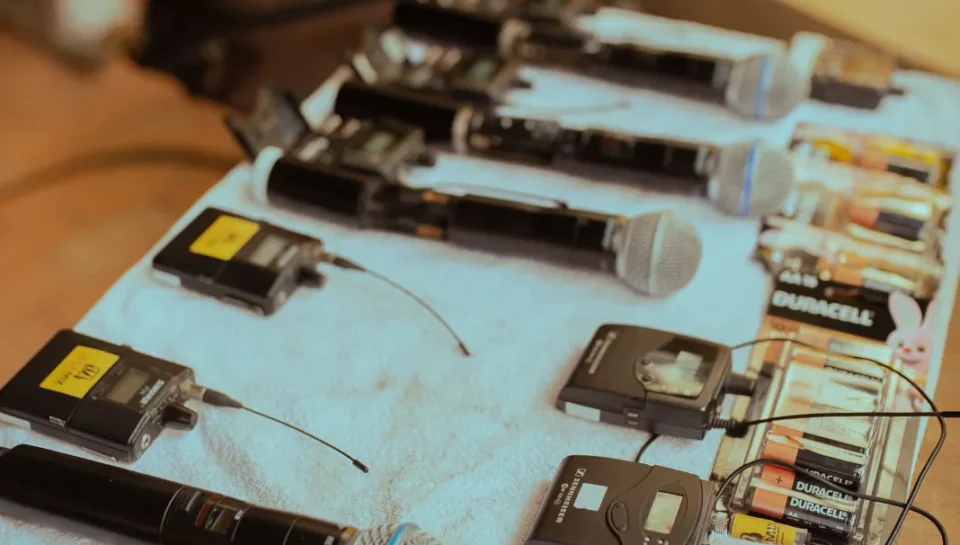
- Wireless systems give freedom but need a little planning so frequencies don’t clash with other kit in the venue.
And a tip for anyone giving a speech: hold the mic close to your mouth. A mic held at waist height is a very expensive ornament.
Get the sound check timing right
A sound check isn’t something to squeeze in while guests are arriving. Aim to have the system set up and tested well before doors open, with enough time to fix anything that doesn’t behave.
Check every mic you plan to use, ideally with the person who will be speaking. Walk the room while someone talks, so you can hear what the guests will hear. If a band, a DJ or live performers are involved, allow extra time for them to run through their own set. Late access to a venue is common, so ask early about set-up windows and build in a buffer.
Work with the venue’s limiters and curfews
Many UK venues have noise limiters, which cut the power if levels go over a set point, and many operate under licence conditions or a music curfew. These exist for good reasons, often to keep neighbours happy, and they apply whatever the event.
Ask the venue early about:
- Any decibel limit and how it’s measured
- Where the limiter sits and who controls it
- What time music must stop, and whether speech is treated differently
- Any restrictions on outdoor sound
A good system designed around a limit can still sound great. Careful speaker placement and tuning let you get clear, even sound at a lower volume, which beats turning everything up and having the power cut mid-song.
Know when to bring in a professional
A simple system can be fine for a small, quiet gathering. It’s worth calling in a professional when:
- Guest numbers are large, or the space is awkward
- You have several speakers, live performers or a running order with lots of changes
- The event is outdoors, in a marquee or at a venue with strict limits
- Sound sits alongside screens, lighting or effects and needs to work as part of one plan
- The speeches or presentations really matter and can’t be missed
A professional PA hire company will visit or review the venue, recommend the right kit, set it up and stay to run it, so you can enjoy the day rather than watching the mic stand.
Talk to us about your event sound
Core Productions provides sound and PA, LED screens and video, lighting, pyrotechnics and effects, and DJs for weddings and corporate events across the UK. If you’d like help planning the sound for your event, get in touch via our contact page. We typically reply within an hour.